
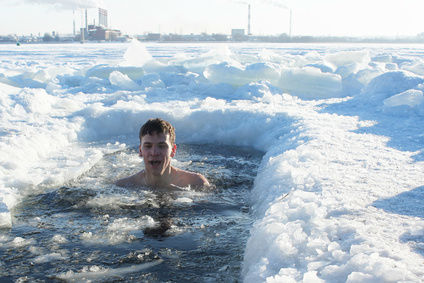
In wintertime, throughout the US and worldwide, some brave individuals immerse themselves in icy-cold oceans, rivers and lakes, as part of a ‘Polar Bear Plunge.’ In the US, these events are often held on New Year’s Day, and at other times during the winter from October to April.
This tradition is based on an age-old Northern European custom of jumping straight from a sauna session into a cold lake. This practice is believed to boost the immune system, and enhance vitality and libido.
In 1903, the Coney Island Polar Bear Club was founded in New York City, and other cities across the US soon followed suit. Many of these clubs donate the proceeds from their events to charity.
If you are thinking about participating in such a plunge, be aware that there are certain potential benefits, as well as certain potentially serious health risks.
Pros
Polar Bear Club enthusiasts claim that a winter dip in icy water makes them feel refreshed and exhilarated. It is also a social activity that many people do in teams.
Immersing yourself in icy water may help to soothe sore muscles.
The dip may also increase the presence of glutathione in the body, a potent antioxidant that boosts the performance of other antioxidants.
Some research has found that cold temperatures have the potential to activate brown fat in adults. Brown fat is a type of fat that burns energy, as opposed to storing it. In this way, a Polar Bear Plunge could possibly contribute to weight loss.
The cold water may also help to decrease uric acid levels in the body. When uric acid levels become too high, it may lead to gout, kidney disease and high blood pressure. Many people who are overweight or obese have heightened uric acid levels. Lowering them may therefore aid in preventing certain chronic diseases.
Cons
When you envelop your body in freezing water, especially if you jump in quickly, the shock of it leads to a gasp, and then rapid, involuntary breathing. You may be unable to hold your breath. According to Dr. Alan Steinman, an expert on cold-water survival and hypothermia, this practice “can be a problem if your head’s underwater.”
The body reacts to the sudden cold by constricting the blood vessels closest to the surface, raising your blood pressure.
As your blood rushes inwards to keep your organs warm, you may lose coordination and adequate muscle control. The muscles in your arms and legs may even become temporarily paralyzed. Dr. Thomas Trail of Johns Hopkins University School of Medicine says, “your muscles get cold and are instantly paralyzed by the hyperventilation, and you can become very weak. You hear of people drowning in a minute or two, even when they’re just a few feet from safety.”
Because of these health risks, people who have a history of irregular heartbeat, heart disease, stroke, aneurysm or blood pressure problems should re-think this activity, as it may increase their risk of a cardiac incident.
Even healthy people may experience irregular heartbeat after performing a Polar Bear Plunge, as a result of the rush of adrenaline it produces.
Many cities’ Polar Bear Clubs put certain safety measures in place to protect their participants. The Maryland State Polar Bear PlungeFest, for example, recruits divers to patrol the area where the plunge is taking place, and does not allow anyone to stay in the water for more than five minutes.
If you decide this is something you are going to do, despite the risks, there are certain ways you can prepare and protect yourself:
Take daily showers at increasingly cold temperatures to acclimatize your body to the upcoming shock.
Do not drink alcohol before the plunge, as it causes your body to lose heat more quickly, and makes it more difficult to warm up.
 Bring warm, dry layers of clothing, including socks and shoes, along with you, and dry yourself with a towel as soon as you exit the water. If your body stays too cold for too long, you may develop hypothermia, a serious condition in which breathing and heartbeat are compromised. Hypothermia can lead to death if it is not addressed quickly enough.
Instead of jumping straight into icy water, wade in slowly, to reduce the chances of having a heart attack from the sudden temperature change.
-The Alternative Daily
Sources:
http://www.nbcnews.com/health/planning-polar-bear-plunge-how-your-body-reacts-1C6437407